
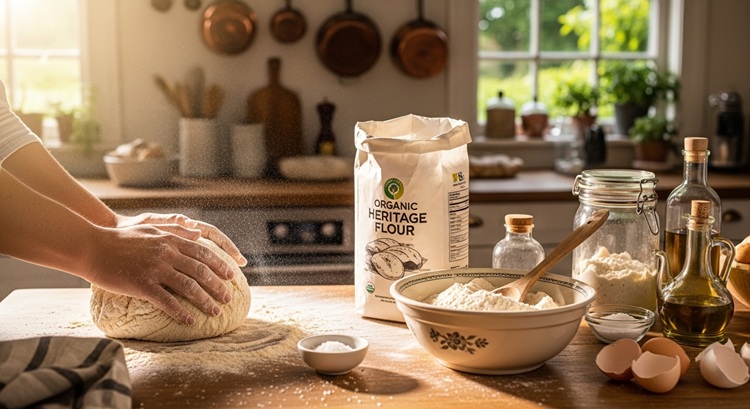

Organic flour is quite different. It has variations in milling and protein content. This can impact how your dough or batter behaves.
If you treat it exactly like standard flour, results may vary. It needs minor yet significant modifications to achieve a consistent texture and structure.
Here are some tips to achieve consistent results when using organic flour.
Table of Contents
Understand the protein content
First, examine the level of protein. Not all organic flour is standardized as conventional flour. So, two all-purpose organic flour brands may behave differently.
Higher protein flour develops more gluten. This leads to chewier textures. Reduced protein flour makes baked goods tender. Suppose your recipe turns out too dense or too soft. Protein variation is often the cause.
Adjust hydration gradually
Organic flour has varying capabilities to absorb water. This is based on the way it was milled and stored. Whole-grain versions, specifically, absorb more liquid.
Do not add all the liquid at once. Withhold some. Then, add slowly during mixing. This provides you with more control over the consistency. It prevents overly sticky or dry outcomes.
Sift for consistency
Certain organic flours contain a coarser texture. They could even have small grains of bran. This is why sifting it is important. It assists in forming a smoother texture.
This also aerates the flour. Thereby, enhancing the blending process. It can also make the end product lighter.
Monitor gluten development
The kneading time of organic flour might take a little more or less time. This depends on the quality of the protein.
Observe the development of the dough. This is important when mixing and kneading. Test elasticity and smoothness instead of time.
Use fresh flour
Organic flour has fewer preservatives. Hence, a shorter shelf life. Over time, natural oils in the flour can degrade. This affects:
- Flavor
- Performance
- End product.
Keep it in a dry airtight box. Store it in a cool environment.
Adjust leavening as necessary
Organic flour has varying density and moisture-absorbing capabilities. Therefore, your standard baking powder or baking soda usage might not always yield the same rise.
Suppose your baked products turn flat. Next time, add a little more leavening in small steps. In case they lift too fast and fall, reduce it.
Mix gently for delicate recipes
Do not overmix the dough. Especially when making pastries like:
- Cakes
- Muffins
- Biscuits.
Organic flour may also develop gluten more quickly or disproportionately. This results in tough textures.
Blend until ingredients are mixed. This helps maintain a softer crumb.
Test on small batches
Suppose you are working with a new type or brand of organic flour. In that case, test a small amount first. Then scale up.
This will enable you to determine how it behaves in terms of the:
- Texture
- Water content
- Baking time.
After knowing how it performs, you can standardize your process. This way, you won’t have to waste ingredients.
Blend with other flours if need be
Your organic flour recipes might have a poor texture. In that case, you can mix it with another type. For example:
- Bread flour
- Cake flour.
This will allow you to adjust the structure.
The final note
Organic flour can yield excellent results. But it works best when you adjust the method instead of working with fixed measurements.